
Check out Deane Greene’s article on Palmers Amaranth. I’ve seen this plant up and down the West Coast from Portland to LA. My friends’ neighbors in Portland who are from Fiji, asked to come over and take it out of their garden. It ended up on their dinner table as a delicious curry.
More Weed
Cant get enough about weeds, right? The latest crop of UC Master Gardeners and I had an enjoyable afternoon last week at Filoli Gardens (www.filoli.org) Super fun. Here’s my presentation for those who want to go deeper!
check it out: Weeds UC MG pres 3 2013 copy-1
And, here I am breaking down a 13 square inch of a random field.
Non-native Opportunists – with Benefits
Weeds. Just the sound of that word makes gardeners the world over roll their eyes and cringe. What they are not realizing, however, is that far from being the bothersome pests they are made out to be, these hard working plants are loaded with benefits. Like what? Well, like being indicators of soil conditions for one. Did you know that nutsedge (Cyperus esculentus) will only grow in wet sites? So, if you see it growing , as I did recently in an irrigated container planting, you might get the clue that your container isn’t draining.
It’s true. Plus that little plant is actually cultivated in some parts of the world for its nutritious rhizome. “Tigernuts” aren’t some culty, hunting-club, macho super food. They are the humble roots of a “weed”. There are a thousand more examples.
Here in California, we have a thing with “Sourgrass” or “Bermuda Buttercup” (Oxalis pes caprae). In the winter it’s everywhere. I mean literally on every available surface – or so it would seem. It’s the backyard “weed” that no one seems to be able to conquer. So why conquer it? Why not enjoy it’s benefits. There are certainly less attractive plants in the world. After all, it was introduced into the nursery trade as an ornamental. It offers cover and stability on disturbed sites and prevents erosion. Heck when lemons are scarce and oxalis is abundant, you can even make lemonade from it. Here’s how:
BACKYARD LEMONADE
2 qts Oxalis – pull it right out of the garden, discard the roots and tubers (carefully). Just use the stems, flowers and leaves.
1 cup local honey
Abundant spring water (I’ll use about a gallon for 2 qts of plant material)
Options: Add Dock (Rumex crispus, lemons)
In a large kettle, cover oxalis with water and boil for 15 – 20 minutes. Remove from heat, carefully pull out some of the cooked greens and pour hot liquid through a fine strainer. Stir in honey and let it dissolve in the strained lemonade. Delicious hot or cold.
Michael Pollan’s letter to the Farmer in Chief
I slavishly read every single word this man writes. It’s so irritating.
Read this, and plant something right afterward. I’m sprouting sunflower seeds. Damn fossil fuels.
http://www.nytimes.com/2008/10/12/magazine/12policy-t.html?_r=1&ei=5070&emc=eta1&oref=slogin
Deep-rooted issues: The SF VICTORY GARDEN

Victory from oil dependence. Victory from having to buy unhealthy food at high prices. Victory from shopping at big box stores. The event was put on by Slow Food Nation and was quite the media circus. Of course Alice Waters was there (did you even have to ask?_) Gavin Newsome and his stepford girl were there, the NY Times was there.
Even my permaculture class was there. We decided that it would be a good idea for the class to experience food justice in its most public form. Plus they gave us cool t-shirts and lunch. There were literally dozens of photographers, journalists, and onlookers all witnessing a phenomenal event. The first food garden to be planted in a public space in San Francisco since 1943.
I volunteered to help John Bela and his crew of carpenters and urban farmers set up for the event. There was a lot to move around and put into place before the cameras started to roll. I actually got to MOVE DIRT WITH A JOHN DEERE FORKLIFT. It was awesome!

it's time to get this beast in gear
My three-year-old godson would have LOVED to tag along to help with the heavy liftin’. It was a lot of hard work, but it paid off. On Saturday, the whole class rallied and we planted our keyhole beds with corn, beans and squash (all grown by Green Gulch and City Slicker Farms). This classic combo is one of the defining “guilds” in permaculture and is sometimes refered to as “the Three Sisters”. The native people of North America had this all sorted and nowadays, smart folks can see these ‘sisters” as an example of plants that grow together to help each other out.
A threesome that actually works without any drama.
The beans climb on the corn which shades the vines as they grow. The bean flowers actually attract pollinators to the squash vines which function as the “skirt” around the whole planting, conserving moisture in the soil by shading the roots. These sisters are doing it for themselves. And we helped.
The class was stoked, and by mid morning, we had the whole thing planted and watered in.

getting the three sisters all hooked up
The organization planned this garden to showcase local, urban food production for the “Come to the Table” Slow Food event at the end of August: http://slowfoodnation.org/
Check out the future of food. It’s a deep-rooted issue.

civic center plaza - in my hometown
Posted in Deep-rooted issues, Growing Food
Stridolo – so italian even italians dont know it

I’m a sucker for a seed catalog, so when Franchi Sementi began offering seeds for an Italian annual called “Sculpit” or “Stridolo” I bit the bait. The plant, Silene inflata, is super easy to grow and, according to one seed source it’s a ” rare annual bushy plant with thin delicate, slightly aromatic leaves. Leaves are eaten raw in salads or cooked in risotto and soups, even as a flavouring for omelettes, quiches and stuffing.
So Italian that there is even an annual Stridolo Fair.” So Italian that most Italians I know have never heard of it. Including my entire family both here and in Italy.
I must say, I can picture it growing along Italian roadsides and in the rocky fields so common in Abruzzo and Molise. It’s an beneficial insect attractor, and I had it interplanted with my peas this year. I noticed masses of bees raiding the blooms, and the inflated calyxes puffed and nodding in the wind. The leaves are okay in a salad or a frittata, but nothing special. It seems more like a foragers kind of food. That said, it looked great interplanted with my pea vines. And, it made a nice texture/color/flavor addition to my salad mix.
I’m going to leave it in for the season. There’s something about seeing the olive shaped leaves and comic balloons decorated with simple white petals that is almost appealling enough to warant a full-on “sagra di stridolo” in my corner of the world.
Posted in Growing Food, Plants with Benefits
American Chestnut
The Life, Death and Rebirth of the Perfect Tree

Disasters are not always big loud booming events. Some are silent, protracted affairs that can take generations to manifest. The story of a disaster is the stuff journalists live off of. After all, none of us can keep our eyes off a trainwreck, no matter how horrible, and someone is going to tell the story.
Susan Freinkel’s new book from UC Press is more than just good solid journalism. It’s a story that affects all of us. The American chestnut , Castanea dentata , was the keystone species of most of Eastern North America up until about a century ago. This tale of death and rebirth is inspiring. We’re going to have a public conversation tonight at the the Book Bay at Fort Mason in San Francisco. I’m looking forward to getting her take on how this story can tell us something here in California about our own Sudden Oak Death (mocking acronymed “SOD”) and that pesky Phtophtera ramorum that is gaining the upper hand in the oak drama. Stay tuned…. and if you havent yet picked up Susan’s book, grab it. It’s a fine piece of work. Trust.
Posted in Eco-literacy, Trees
I, Borage

Plants with Benefits:
I, Borage
Borago officinalis
Bright blue borage flowers are a familiar sight in my garden. Once you plant it, it self-seeds readily, so get ready to have lots. It’s very well adapted to Mediterranean climates (since it’s native place is Syria and parts of the Middle East) but it has naturalized throughout Europe, and is doing a pretty good job of taking over San Francisco.
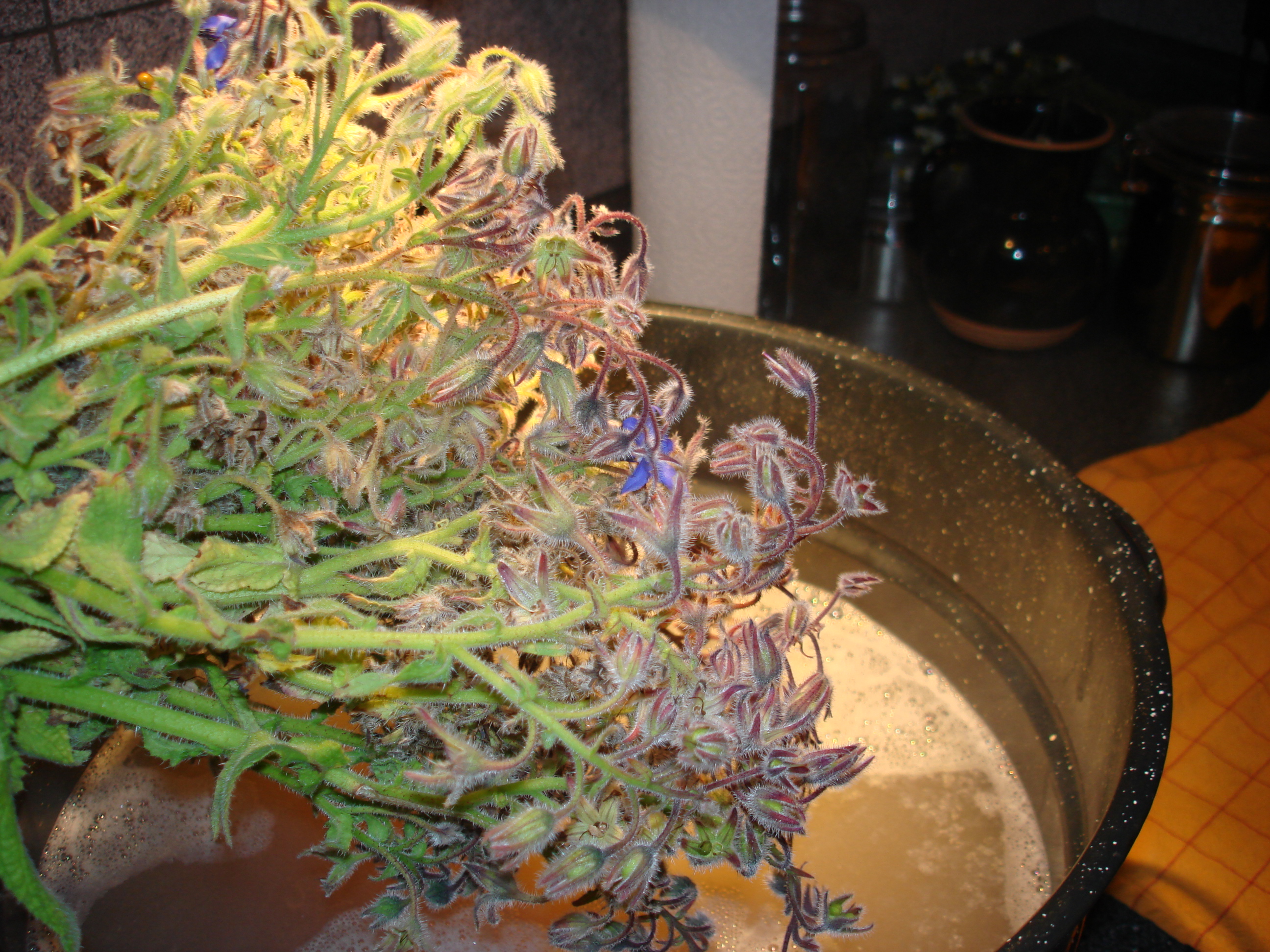
The word is said to come from the Latin burra – meaning wooly – a good descriptor for the irritating fuzzy burr that coats this plant. Check out the close up of the flower heads.
So the Romans had a good time with language, and the word for courage (sort of ) rhymes with borage both in English and in Latin. Here’s a little first century haiku:
Ego borrago
Gaudia semper ago
(I, Borage, Always bring courage)
There might be a bit of truth to that. According to the English Herbalist John Gerard in his 1597 Herball: “There be also many things made of these used everywhere for the comfort of the heart, for the driving away of sorrow and increasing the joy of the minde. The leaves and floures of Borage put into wine make men and women glad and merry and drive away all sadnesse, dulnesse and melancholy, as Dios corides and Pliny affirme. Syrup made of the floures of Borage comforteth the heart, purgeth melancholy and quieteth the phrenticke and lunaticke person.”
Hmm, phrenticke people everywhere and not enough borage. I took a page from Gerard’s book and brewed up some borage ale.
So here’s the breakdown:
The Plant: Borage (Borago officinalis)
The benefits: Great bee forage, insect attractor, purgeth melancholy, tastes like cucumbers, looks terrific on a sweet potato or golden beet salad, and can be used to brew beer (I’ll let you know how it turns out). The seeds contain gamma linolenic acid – the prized ingredient, among others, of borage oil. Borage oil may help to balance the hormonal system. It also is purpored to have anti inflammatory properties, plus it increases episodes of courage, where needed.
Dharma in the Dirt
Wendy Johnson is so inspiring. The woman has devoted her life to the garden – and the benefits are enormous. Working with her was a delight, and if you’ve ever been to the Green Gulch Farm and Zen Center in Marin Co. California, you’ll see what I mean. It’s AMAZING! And their food is good, too. Check this article in the New York Times. I gave that reporter twenty minutes of brilliant sound bytes, so she used the most boring throw-away line ever. Ah well. http://www.nytimes.com/2008/05/08/garden/08zen.html?_r=1&ref=garden&oref=slogin
What if every time you set foot in a garden you got something back?
That’s the whole point, right? I love the idea of Horticultural Therapy – it’s a real discipline with real practitioners. Check out the HT Institute in Denver. www.htinstitute.org These folks are serious gardeners, serious enablers. They want to help you keep gardening even into your 90’s when your hands are falling off and you can remember what soil is for. Continue reading
 Gardens with Benefits

You must be logged in to post a comment.